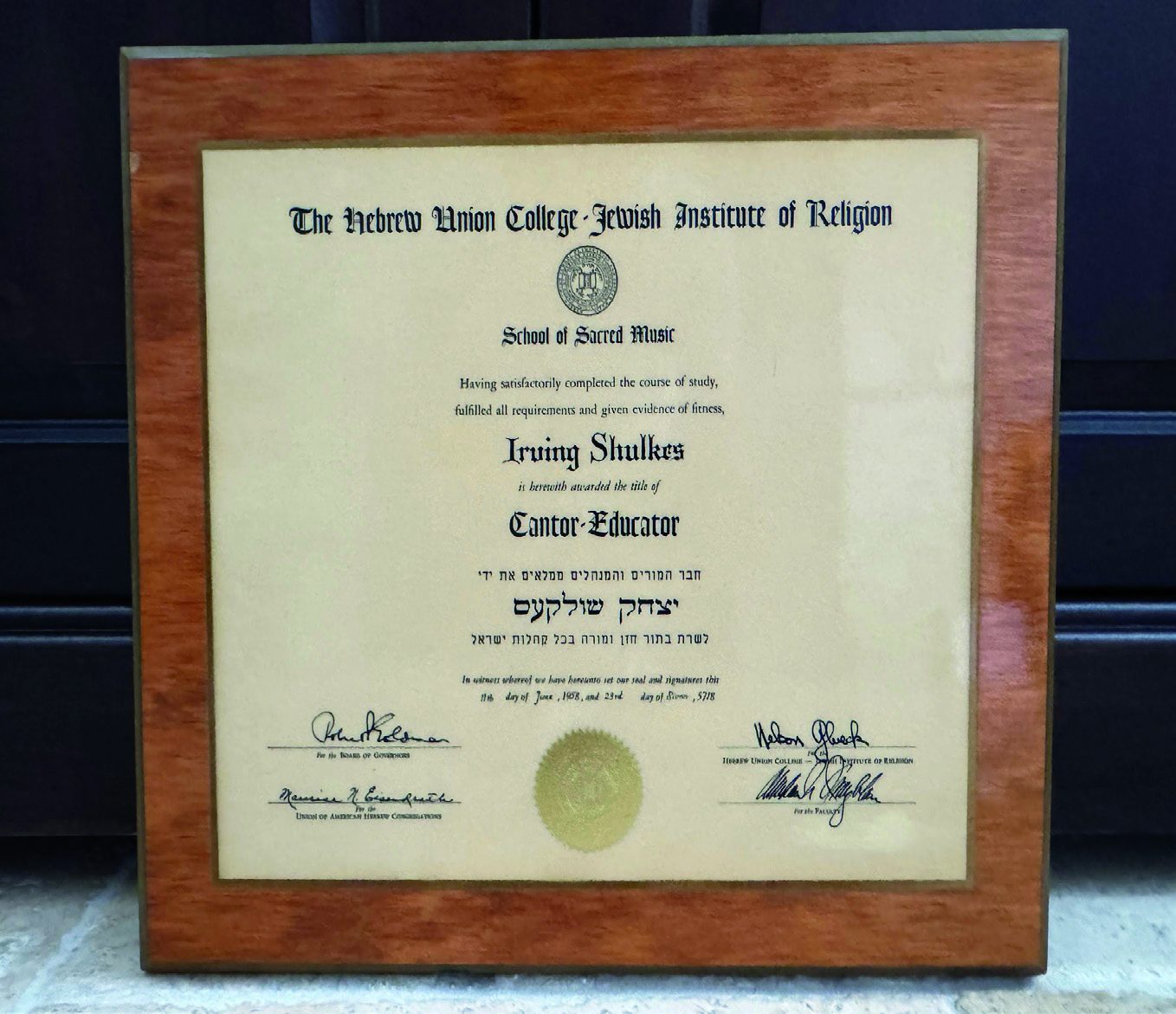
This was also the year of my graduation from the Hebrew Union College - School of Sacred Music in 1958 with the degree of Cantor- Educator. When I returned from Israel, my congregation, Temple Sholom in Queens, New York, offered me the position as Cantor- Principal of the 250 student Hebrew and Sunday school that covered the first ten grades, through confirmation. I was 28 years old at the time and was greatly moved by the offer which I readily accepted.
Much of my time was spent observing the teachers in the classrooms and making sure that our curriculum was being properly taught and getting through to the student body. Our assemblies for the various age levels were wholesome and innovative and were supervised by an assistant principal from a public school who was a member of our religious staff. What
I appreciated and moved me deeply was the staff of 18 teachers who were fully devoted and committed to the Hebrew and Sunday school. My time there was very demanding. I was lucky to have an excellent assistant, Lenore Ginsberg, who was very helpful in achieving our goals. The days were quite busy but they were enjoyable and fulfilling.
Is God in That House?
At times, I experienced the element of surprise in my work as a cantor. Following one Rosh Hashanah morning service, I took off my robe and tallit, put the choir books away, and being the last one to leave the temple, I locked the doors and exited. As I walked down the temple steps, I saw a bearded Orthodox man with his tallit bag tucked under his arm looking up at me. He pointed to the synagogue. “Is God in that house?” he asked, almost angrily. His tone took me by surprise. He was older than I, in his 60s, and I wanted to be as respectful as I could. His position was clear to me - his religious practices were correct and right, and it was I who wandered from his vision of the one and only true path.
“Sir,” I answered, “God is everywhere.”
“Yes, yes, I know” he continued, “but is God in that house? - Is God in that house?”
I knew there had to be an answer, and I still don’t know how it came to me in that stressful moment. It was the “Ashrei” prayer that is very widely known and chanted in the liturgy. He was a few feet away from me as I quoted, “Karov Adonai l’chol korav……. God is near to all who call upon Him in truth.”
He looked at me one last time, uttered “harrumph,” and quickly walked away. There was a time in my life when I held the same religious beliefs as he did. One of the values I tried to learn early in life, however, was to respect the beliefs of others, even if they differ greatly from your own.
Studying at Teachers College
Just to recap, I enrolled at Teachers College in September of 1951. Then, I was drafted into the army for two years. This was followed by four years of study at cantorial school. Now, in 1958, continuing my studies at Teachers College in the evening, I decided to change my course of study from speech to choral conducting for my master’s degree.
I was fortunate enough to have the stimulating experience of working with Harry Wilson (1901-1968), a very gifted music professor. In his conducting class, each of us was videotaped conducting the entire class in a four-part musical selection of our own choosing.
The selection that I chose to conduct was a four-part arrangement of “Adon Olam” (The Lord of all) in the Hebrew language composed by Salomone Rossi (1570-1628), one of the towering Jewish musical figures of the Italian Renaissance. I prepared 60 copies for distribution to the class, a short introduction of the composer’s life, and guided them in the Hebrew pronunciation. It was well received, particularly by the dozen or more nuns in the class. What amazes me to this day is the way the entire class eagerly responded to this three-hundredfifty-year-old musical arrangement of the “Adon Olam” in Hebrew.
For many in the class, it was their first exposure to the music of the synagogue. How exciting it was for each of us to have our conducting techniques analyzed afterwards. In this same college chorus, we sang the oratorios of the great masters, Handel, Haydn, Beethoven, Brahms and Mendelssohn, among others.